Ace Combat 8: Wings of Theve review – thrill-packed campaign takes this long-running series to new heights
Nog geen ander medium dat Zonactu volgt, meldt dit bericht.
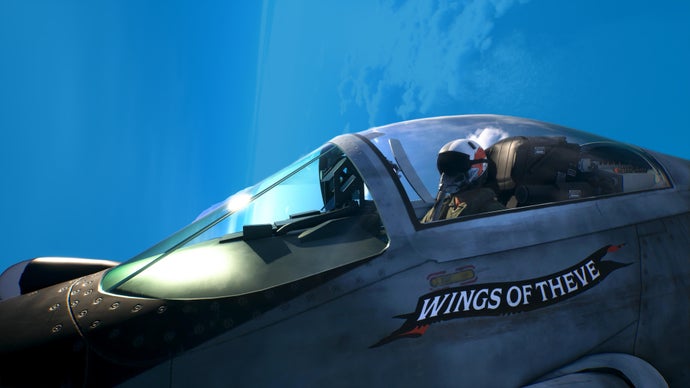
Let's chase 'em off, Rex! Two more missiles arc toward a hapless enemy F2-A, droplets peppering my windshield as I skim past a glowering grey cloud, dulling the distant explosion. Visibility is garbage . No kidding, Tasha. The Endurance is being targeted . Uh-oh. Tonitrus Spear arriving in two minutes! They've got a high-output laser and a broad-range jammer. Sounds like a bad combo. The cockpit rattles as I climb, an insistent red flash warning me my Tomcat's icing up. But I can see the laser, and soon after the airship it's emerging from. It's in my sights. I've got this.
Wait! There are are two lasers! I have no longer got this. This is suddenly in an entirely different postcode. Even as one falls, the overlapping chatter in my ears gets busier still. Take both of them out or the carrier will take a Spear strike. Move. Don't think. Quickly now. 45 seconds. Tasha's anxious; Coster, a man of few words, knows when they're most needed: Don't panic. Stick to your training. There's a furious shudder as I swerve into another ice cloud and a missile whistles by. Arriving in 30 seconds. The music swells, the string players bowing with an urgency that suggests even they recognise things are getting desperate. 10... nine... eight... The airship finally comes into view. Seven ... six...five...four... It's too late. I vainly launch one last LAAM, knowing it's not going to hit in time. Three ... two... one... It's over. I slump in my seat, having spent the last few minutes perched on its very edge.
But then... Shot landed! What? A cutscene kicks in showing the last airship exploding. Joker 1, target destroyed. I instinctively leap up, and my DualSense Edge takes its maiden flight.
Wings of Theve's intense, often exhilarating, occasionally downright euphoric campaign centres on an act of propaganda. The eponymous 'Wings' is a fiction: an invention of a media guru to bolster morale during an ongoing conflict that has left people seeking symbols of hope. When your predecessor – whose own kill count hasn't even reached single figures – is downed during the prologue, you're invited to take up the mantle. It's a smart way to align you with the character you’re inhabiting: this is a series, after all, whose goal is to make you feel like a seasoned fighter pilot. Part of the brilliance of Ace Combat 8 is how it both reminds you that you're ultimately a fraud, whilst also giving you moments where you could be convinced that you're Maverick.
The Top Gun comparison has been made countless times before, of course, but it's hard to ignore the degree to which Wings of Theve owes a debt to Joseph Kosinski’s 2022 sequel, specifically. It's not just its head-on replay camera (which admittedly doesn't have the same effect as a demonstration that one of cinema most bankable stars – pre-Digger, at least – was flying a plane for real) or cutscenes that mimic some of the film's most memorable shots. Rather, it's as if Bandai Namco Aces was inspired by one of the most thrilling action movies of the 21st century: every mission feels like the most extravagant set-piece of a Hollywood summer blockbuster.
For better and worse, that carries over into everything that happens in between. One of the big differences between Wings of Theve and its forerunners is its investment in story. There's an introduction that borders on Kojima-like indulgence (which gives me enough time to wonder whether he'd have named the player character Tom-Cruiseman). The first-person interstitials never quite sold me on the wisdom of having a silent protagonist – nor, indeed, the value of its limited inputs, such as look and zoom controls and the occasional 'press X to shake hands' prompt. Yet the inherent awkwardness of the mute hero is tempered by the choice to have your precursor linger like an Obi-Wan-esque spirit. He's a combination of internal monologue and exposition device, delivering portentous lines like "the ocean sits there like an open coffin" in a whispery growl that to me sounded awfully like (apologies if this spoils the game for you) Christian Bale's Batman voice.
That adds just a hint of unintentional comedy to the game's serious-minded ruminations on war, which feel like a developer having its cake and eating it. There's much handwringing about the human cost of conflict (though the script seems to reserve greater ire for the evils of social media and how quickly and easily falsehoods can spread and take root in the gen-AI era) and it's not shy of making you aware you're a cog in both the war machine and the propaganda machine. At the same time you've no choice but to embody this role, and in effect become the pilot of legend with the improbable kill count that is inspiring the folks back home.
It's a reminder, too, that while Call of Duty and Battlefield frequently feature in uncomfortable discussions about the military-entertainment complex, Ace Combat has managed to dodge being included in these conversations like, well, a barrel-rolling MiG evading an incoming missile. Ah, but this isn't our world, Chris. This is Strangereal, not Normalreal: a place where enemy planes play dad-rock over open channels to announce their arrival, and one of your wingmen plucks out mournful guitar solos on a carrier at sundown . True, but it also features several real-world planes, unveiled with a similar reverence to which Gran Turismo affords newly-purchased cars. And – space elevators, land battleships, and colossal transports with thousand-metre wingspans notwithstanding – its scenarios feel at least somewhat plausible, not least when we're presented with haunting scenes of devastation that can't fail but evoke the kind of imagery we've seen of Gaza and Ukraine in the last few years. Wings of Theve is so overwhelming, so relentless and so stratospherically daft that for me these concerns melted away during the missions themselves; equally, it's worth spotlighting for those who might not find virtual conflict much of an escape right now.
In any case, it all makes for a surfeit of downtime in a game that is at its best when it cleaves closest to that opening quote from its 11th sortie: Move. Don't think. Quickly now. After the fact, I realise this is perhaps as close as Wings of Theve gets to a mission statement. Few series communicate a sense of urgency quite as well as Ace Combat, and if this particular entry's most arduous sorties threaten to unsettle that delicate equilibrium between exhilarating and exhausting, at its finest it delivers a rare kind of sensorial high.
What separates Ace Combat most from its immediate predecessor – and its PS2 heyday – is its focus on spectacle. Yet there's real substance beneath its visual pizzazz. Those clouds, for instance, aren't only responsible for 2026's most jaw-slackening skyboxes, nor some of its best weather effects. Visibility, after all, can be a double-edged sword, making it a key tactical consideration during dogfights. And while venturing into cloud cover can make you a little less cumulo-nimble – even reducing the range of your missile lock-on – that's all the more incentive to tinker with your pre-mission loadout.
On that front, you might be tempted to immediately splurge on new planes with better stats, but it's often more sensible to invest in parts that can extend the range and effectiveness of missiles, as well as decrease your likelihood of stalling or boost your durability. Similarly, teammate commands make a surprising amount of difference, as does your choice of plane. In missions where your attentions are torn – in other words, most of them – you can have them break formation to thin out enemy numbers, while you can instruct them to deploy special weapons, which in some cases can enhance your own capabilities or disrupt your opponents.
It's another consideration in a game that typically – and purposely – gives you too much to handle at any given time. It's not so much organised as meticulously choreographed chaos: if at times the relentless barrage of radio chatter means it's hard to divine which threats you should be prioritising, that generally feels more feature than bug. To live up to your billing, you'll need to learn to parse the vital from the incidental, and when wingman quips are vying with admonishments from other pilots, instructions and updates from various sources – not to mention noisy missile alerts to ramp up the stress – that isn't always easy.
All of which means Wings of Theve can be ever so slightly draining to play in long sessions, demanding as it is of your total attention at all times. Even in the comparatively slow-paced missions, there are developments that force you to lock in before you lock on; to lean forward and snap into focus. You're often invited to go off-piste – there's a fraught moment where you're asked to lend a hand as a rustbucket transport flies through valleys lined with anti-air ordinance. Taking those down as your wingman repeatedly shouts "MANPADS!" might, by this game's standards, seem relatively straightforward. But it suddenly turns into a frantic race against time, as a group of enemy fighters converge and you need to down them all against the clock.
That's typical of a game that never stops finding ways to up the stakes, even during the landing and refuelling sequences that otherwise offer you respite from the mayhem. You can never quite relax until the 'mission complete' text finally pops up. But the problem with so frequently upending expectations is that, over the course of 30 missions, surprises become the norm. Wings of Theve's Shyamalan-level appetite for eleventh-hour twists means that when a mission ends as anticipated, it's hard not to feel a little let down. Equally, it introduces One Last Threat – or an existing one that turns out to be still operational – once too often. If checkpoints ameliorate any frustration, some of these sorties feel distinctly less replayable as the timer ticks well beyond the half-hour mark.
Bar an early difficulty spike during an escort mission and one tedious bout of forced aerial stealth (featuring the single most misleading bit of direction I've seen in a video game for some time), the game that feels absolutely sensational in the moment. One mission's third act, where you're left to tackle an entire squadron on your own – the score hitting Hans Zimmer levels of thunderous escalation again and again – delivers a sense of giddy mastery and audiovisual splendour that could persuade even the most hardened cynic of the enduring appeal of simple power fantasies.
I figured the series' biggest online component to date would struggle to live up to the single-player. But as someone who's never been a huge competitive multiplayer guy, I was pleasantly surprised. For starters, healthy first-week sales (and a schedule that cycles between stages, with three per mode active at any time) mean matchmaking times are refreshingly short. During longer waits, or before you launch a sortie, you can have a wander around a large air base where you can spend rewards you've earned acquiring new planes, upgrading and decorating the craft already in your hangar, or perhaps even tackling a quartet of classic Namco arcade games. Costlier planes with more upgrade slots definitely give more dedicated players the edge, but as with the campaign your starter plane can hold its own – and there are some challenges you can only accomplish with lower-grade craft.
Alongside solo and team deathmatches that will prove chastening for many, the main draws are the two PvPvE modes. Co-op Warfare asks you to shoot down human and computer-controlled bogeys alike. Perform well, and you'll accrue stars, eventually being dubbed an Ace. Yet such moments of triumph don't last long, since the title effectively paints a target on your back, your opponents gaining more points if they take you down. While you can tag yourself with the D-pad to ask your allies to protect you – or else mark out an enemy ace – these commands are a better idea in theory than in practice. The pace of the game is simply too fast for these to be consistently useful; more often than not, I'd find an ally's missile already hurtling toward a target as I was about to tag it. Co-op Assault, meanwhile, sets two teams of four a common goal; there's a bit of friendly competition as Alpha and Bravo vie to be the most valuable squadron, but even low-performing players get a sense that they're contributing something to the collective effort.
That feeling is all the keener in the four-player Scrambles and eight-player Emergency Sorties, the spawning conditions for which I'm admittedly yet to fully figure out. In any case, there's a chance after a few games of Assault or Warfare that you'll hear a siren blare, whereupon you're called to take down enemy aircraft or some manner of superweapon. Yes, you're basically collectively chipping away at a colossal health bar against the clock, and there may only be three of each, but for my money these modes come closest to capturing the thrills of the campaign in a repeatable format.
There's plenty of game here, in other words – and that's not always a positive. Part of me thinks a marginally shorter, tauter campaign that excised the weakest missions and took the edit scissors to a couple more would have made it a genuine, copper-bottomed classic. Yet at its very best you could easily be convinced that Wings of Theve deserves to be described in such terms. Either way, it's a game with a laser-guided focus on giving you some of the giddiest highs you're likely to experience in a video game this year. In which case: mission accomplished.
A copy of Ace Combat 8: Wings of Theve was provided for this review by Bandai Namco Entertainment .